
Indexing Capacity Shifts and Web Preparation for AI Agents
Analyzing the recent rise in crawled-yet-unindexed pages within Search Console and emerging preparation frameworks for autonomous web agents.
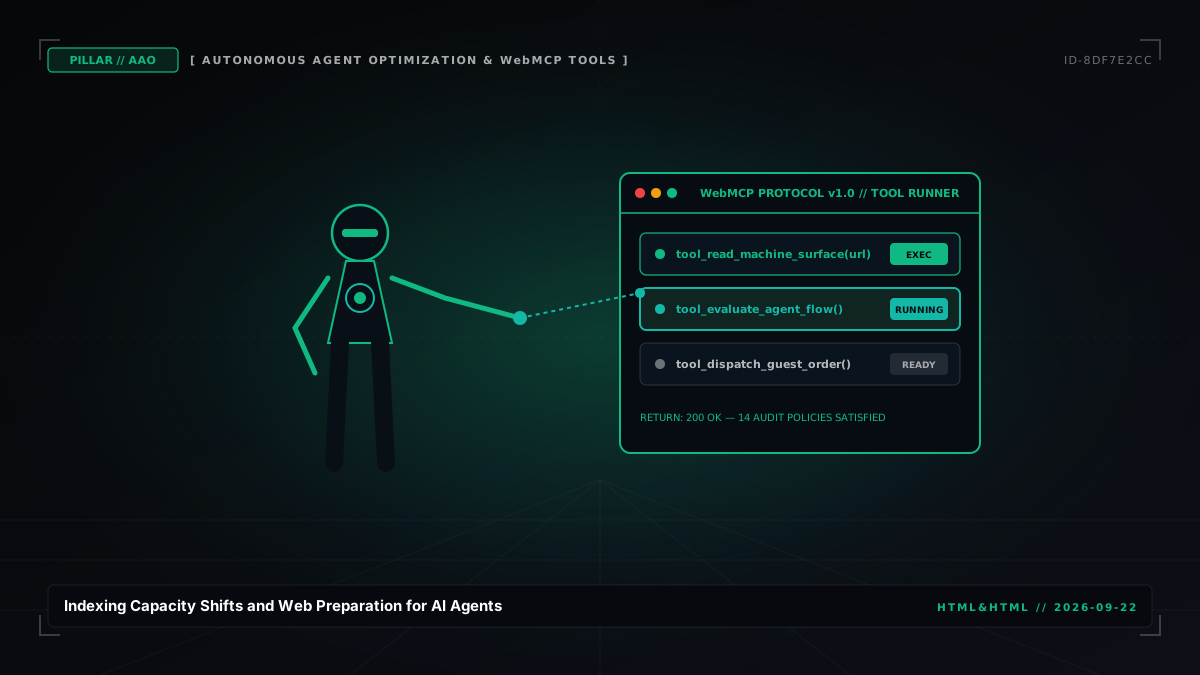
Executive Summary & Core Development
Recent platform data highlights an observable increase in pages that are successfully crawled but remain excluded from primary indexes. This shift suggests tighter resource allocation thresholds and stricter internal quality filters by major search engines.
Concurrently, technical preparations for autonomous AI agents consuming web data are reshaping site optimization priorities. Engineering teams are reassessing server response overheads, structured data fidelity, and raw content density to facilitate programmatic access by external agents.
This dual movement underscores a broader transition away from traditional keyword-centric optimization toward strict machine readability, efficient token consumption, and robust underlying infrastructure.
Why It Matters to Webmasters & Digital Assets
Declining index inclusion rates threaten organic visibility across large site architectures, while the emergence of autonomous agents shifts consumption patterns away from legacy browser rendering. Together, these developments require structural adjustments to ensure machine accessibility and efficient resource parsing across automated clients.
Deep Technical Architecture & Protocol Shift
The divergence between crawl volume and index allocation leads to wasted server compute during discovery phases. Low-value or redundant URLs face immediate exclusion under stricter storage constraints.
Furthermore, agent readiness demands cleaner DOM trees, optimized server-side rendering, and low-latency response times to support programmatic traversal without breaking rate limits.
Multi-Model Retrieval Dynamics & Engine Comparison
Direct Impact Matrix Across the 9 Pillars
Production Code & Configuration Specification
Step-by-Step Engineering Audit & Action Protocol
- Audit Search Console indexing reports to isolate structural patterns among crawled-yet-unindexed URL clusters.
- Analyze server access logs to evaluate crawler resource consumption, rendering overhead, and response latency.
- Validate structured data implementations and enforce strict canonicalization to mitigate duplicate path traversal.
This brief does not republish the external article; it is independent HTML&HTML analysis grounded in the source.
Original source ↗You have the context. Now measure your own website.
llms.txt, AI crawler access, GEO, AEO, LLMO, AAO, RAG, E-E-A-T and the technical foundation are evaluated in one scan.
Check My AI Visibility Free →