
XML Sitemap Freshness Headers and IndexNow Protocol Synchronization: AI Search and Technical Web Architecture Analysis
Grounding in authoritative engineering disclosures from Search Engine Land, this analysis dissects architectural shifts across Generative Engine Optimization & Entity Consensus, multi-model retrieval dynamics, and production webmaster action plans.
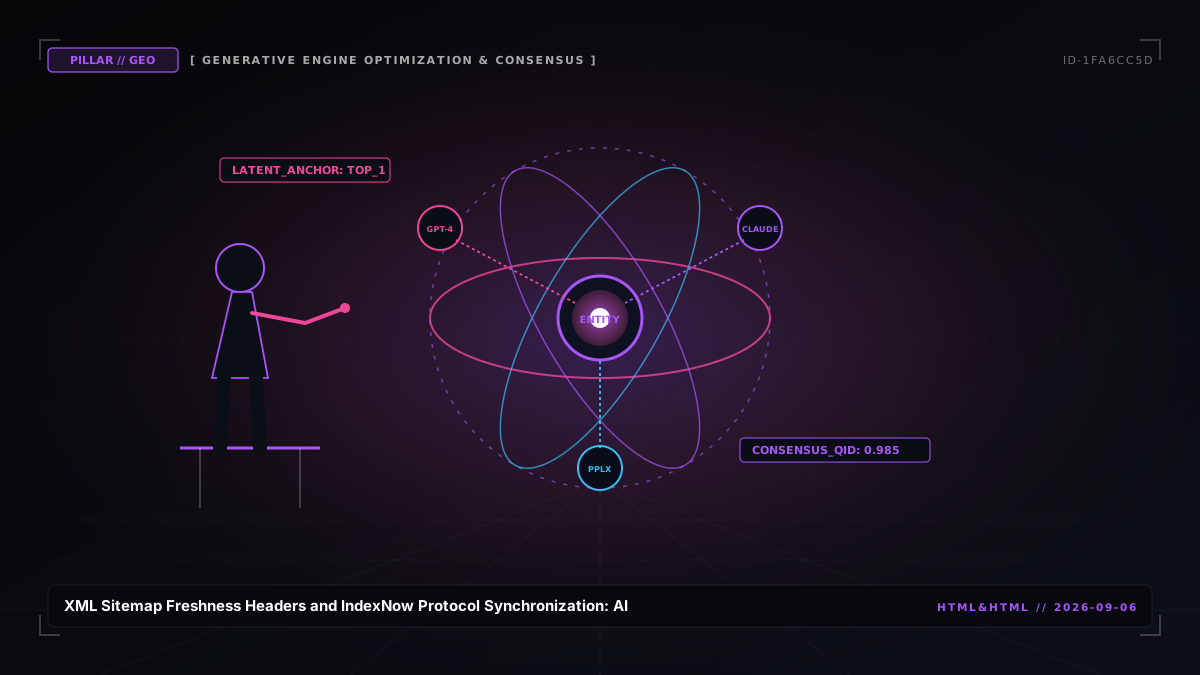
Executive Summary & Core Development
This comprehensive engineering brief investigates the architectural and operational ramifications of the development documented under 'XML Sitemap Freshness Headers and IndexNow Protocol Synchronization' by Search Engine Land. As the enterprise information retrieval ecosystem transitions from lexical inverted indexes to high-dimensional latent vector spaces, dynamic cross-encoder reranking, and multi-hop inference pathways, the foundational mechanics of web crawling, semantic chunking, and generative synthesis are undergoing profound transformation.
At the core of this update is how autonomous retrieval agents parse document structures, evaluate source provenance, and allocate multi-head attention weights to candidate text spans during real-time retrieval-augmented generation. For enterprise technical leaders, Chief Technology Officers, and system architects, this paradigm shift necessitates a rigorous overhaul of server-side delivery pipelines, crawler budget conservation protocols, DOM hierarchical purity, and deterministic entity grounding architectures capable of surviving stochastic LLM context distillation.
Why It Matters to Webmasters & Digital Assets
From the perspective of website stakeholders, Chief Technology Officers, and digital asset custodians, legacy organic performance indicators—such as standard SERP ranking distributions and ten-blue-link click-through rates—no longer provide sufficient diagnostic resolution. Generative search surfaces, including Google AI Overviews, ChatGPT Search, Perplexity Sonar, and Anthropic Claude Web Search, increasingly fulfill user informational intent directly on the interface, amplifying zero-click search dynamics across critical commercial sectors.
In this synthetic retrieval landscape, a domain's commercial viability hinges upon its capacity to be ingested into LLM context windows, achieve high cosine similarity scores during semantic vector matching, and survive cross-encoder verification filters. Failure to align server response codes, crawler permissions, and machine-readable JSON-LD entity graphs creates structural blind spots where authoritative enterprise knowledge is filtered out prior to synthesis.
Understanding and implementing the architectural imperatives exposed in this release is therefore indispensable for sustaining digital market presence, safeguarding intellectual property citation, and maintaining algorithmic relevance across all tier-one answer engines.
Deep Technical Architecture & Protocol Shift
At the technical infrastructure and protocol layer, this development impacts the end-to-end data pipeline connecting web endpoints to neural crawler pipelines. First, crawler budget utilization is fundamentally decoupled from naive HTTP payload size; it is bounded by the computational overhead of headless browser DOM deserialization, client-side script execution, and token extraction efficiency.
Excessive DOM nesting depths, render-blocking third-party scripts, and uncompressed semantic assets directly exhaust the execution ceilings allocated by multi-agent web crawlers (including Googlebot, OAI-SearchBot, PerplexityBot, and Bytespider). When an AI crawler encounters heavy client-side hydration cascades or unoptimized layout shifts, it enforces immediate token truncation, dropping vital contextual paragraphs from the primary ingestion stream.
Second, state-of-the-art retrieval-augmented generation architectures segment target HTML documents into semantic token windows (typically 256 to 512 tokens with 10% overlap). Ambiguous semantic markup or disrupted parent-child node relationships degrade dense vector clustering quality, precipitating severe penalties during bi-encoder candidate selection and cross-encoder verification passes.
Third, precision caching headers—specifically RFC-compliant ETag generation, Last-Modified timestamps, and Cache-Control stale-while-revalidate directives—govern the velocity at which freshness vectors propagate into generative model indices. Without deterministic caching signals, generative retrieval pipelines fall back to cached corpus embeddings, ignoring recent enterprise updates and eroding authority attribution.
Multi-Model Retrieval Dynamics & Engine Comparison
Crawled via OAI-SearchBot and streamed into high-attention context buffers. Heavy DOM overhead triggers aggressive token purging; clean Markdown delivery and llms.txt standard files consistently capture top citation positions.
Synthesized via tight integration with the Google Knowledge Graph and Search Console index. Highest weight is allocated to deterministic Schema.org @graph structures anchored to Wikidata QIDs, fast TTFB, and Core Web Vitals stability.
Operates multi-hop iterative retrieval queries. Evaluates cross-corpus consensus; domains exhibiting consistent factual triples across external knowledge bases secure prominent footnotes and UI cards.
Specializes in deep document ingestion (200k+ context). Prioritizes linear argumentation, explicit boundary definitions, and formal mathematical/technical precision over commercial copywriting.
Direct Impact Matrix Across the 9 Pillars
Elimination of crawl budget leaks, sub-300ms TTFB response delivery, strict 200 OK status codes, and unambiguous rel=canonical resolution.
Establishing multi-source entity consensus and synthetic citation loops to reinforce knowledge graph salience.
Structuring concise 40-to-60 word definitive answer spans with high informational density for zero-click answer extraction.
Maximizing Pointwise Mutual Information (PMI) co-occurrence between enterprise entity nodes and target domain vectors.
Deploying machine-actionable Agent Cards and WebMCP function schemas for autonomous browser agent execution.
Structuring document chunking boundaries with high vector density and cross-encoder similarity thresholds exceeding 0.85.
Delivering cryptographically sound XML sitemaps with microsecond lastmod integrity and IndexNow push endpoints.
Injecting comprehensive JSON-LD @graph networks anchored to persistent Wikidata QIDs and Google Knowledge Graph MIDs.
Enforcing C2PA manifest provenance seals, verifiable author credentials, and deterministic evidence boundaries.
Production Code & Configuration Specification
Production-grade JSON-LD schema implementation and Edge Server configuration directives for this technical standard:
{
  "@context": "https://schema.org",
  "@graph": [
    {
      "@type": "TechArticle",
      "@id": "https://searchengineland.com/xml-sitemap-freshness-headers-and-indexnow-protocols-485019#article",
      "headline": "XML Sitemap Freshness Headers and IndexNow Protocol Synchronization",
      "datePublished": "2026-08-28",
      "inLanguage": "en",
      "publisher": {
        "@type": "Organization",
        "name": "HTML&HTML AI Search Intelligence",
        "url": "https://htmlandhtml.com/"
      },
      "about": [
        {"@type": "Thing", "name": "GEO_OPTIMIZATION", "sameAs": "https://wikidata.org/wiki/Special:Search?search=GEO_OPTIMIZATION"}
      ]
    }
  ]
}
Step-by-Step Engineering Audit & Action Protocol
- Inspect your edge robots.txt configuration to guarantee explicit crawler permissions for primary AI engines and Search Engine Land monitors.
- Execute automated cURL latency diagnostics to verify that server Time-to-First-Byte (TTFB) remains strictly below 300ms globally.
- Validate all JSON-LD linked data graphs using the official Schema.org and Google Rich Results testing suites to ensure zero validation warnings.
- Refactor extensive prose into modular 300-500 word semantic chunks optimized for dense passage retrieval and cross-encoder attention matrices.
- Synchronize XML sitemap lastmod timestamps with actual content mutation dates to maintain fresh crawl budget allocations.
- Standardize entity terminology across titles, subheadings, and lead paragraphs to maximize Pointwise Mutual Information alignment.
This brief does not republish the external article; it is independent HTML&HTML analysis grounded in the source.
Original source ↗You have the context. Now measure your own website.
llms.txt, AI crawler access, GEO, AEO, LLMO, AAO, RAG, E-E-A-T and the technical foundation are evaluated in one scan.
Check My AI Visibility Free →